
Understanding the Universe: From a 6,000-Year-Old Sky to 13.8 Billion Years
📖 11 min read
Four hundred years ago, most educated people in Europe were sure of two things: the universe was about 6,000 years old, and it was not much bigger than the orbit of Saturn. Today we know it is 13.8 billion years old and at least 93 billion light-years across. Understanding the universe took us from that small, cozy sky to a cosmos almost beyond imagining — and the story of how we got there is as gripping as the facts themselves.
AI illustration generated with Adobe Firefly
TL;DR — What is the story of understanding the universe? It is humanity’s slow climb, over about 2,500 years, from guessing the sky was small and young to measuring a 13.8-billion-year-old cosmos born in the Big Bang. We got there not by faith or guesswork, but by measuring shadows, starlight, and the faint afterglow of the beginning itself.
Quick facts
- The universe is about 13.8 billion years old.
- The observable universe is roughly 93 billion light-years across.
- It holds an estimated 2 trillion galaxies, and we can see only about 10% of them.
- Around 240 BCE, Eratosthenes measured the Earth’s size to within a few percent.
- The Sun fuses about 600 million tons of hydrogen every second.
- The first atoms formed about 380,000 years after the Big Bang.
How We Came to Understand the Universe: From Myth to Measurement
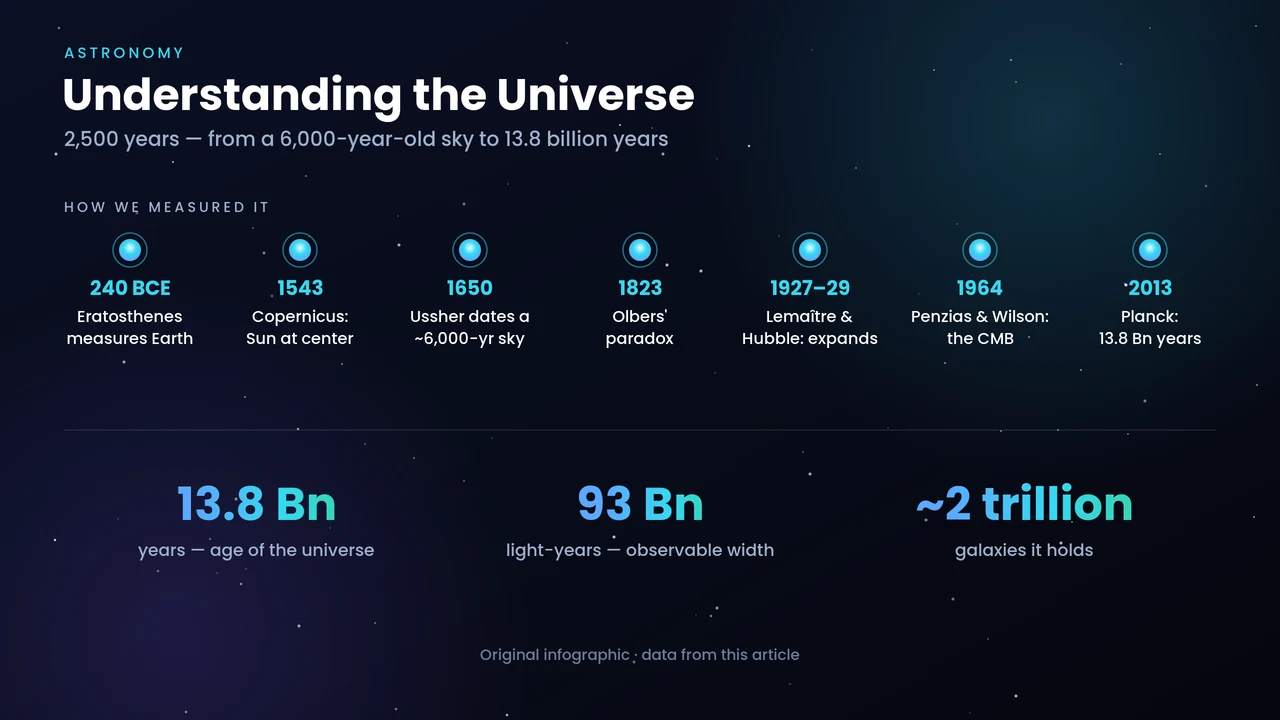
Understanding the universe began the moment people stopped only telling stories about the sky and started measuring it. Around 240 BCE the Greek scholar Eratosthenes used the shadows of the midday Sun to calculate the size of the Earth — proving, for the first time, that the cosmos could be measured rather than merely imagined.
Every early culture built a picture of the heavens. Some imagined a flat Earth under a domed sky; many placed our world at the center, with the Sun, Moon, and planets carried around it on turning crystal spheres. These were not silly ideas. They matched exactly what people could see with their own eyes, and they answered a need as old as humanity: to know where we are and how everything began.
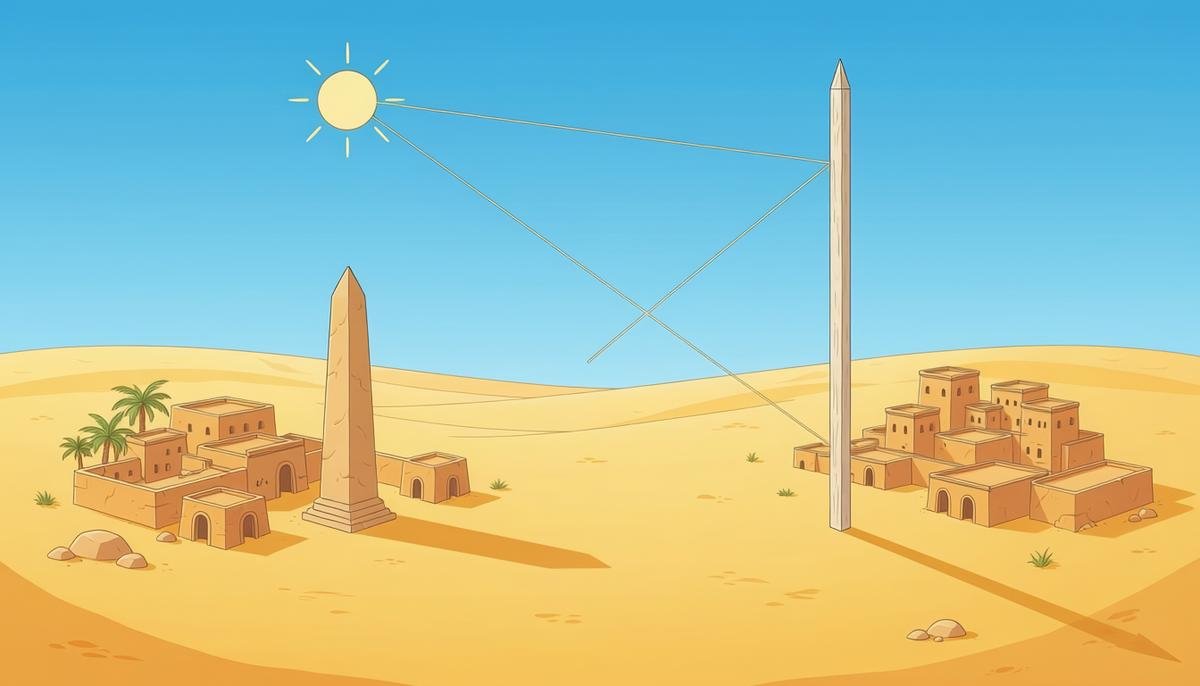
The first real breakthrough was a simple but powerful idea: the cosmos could be measured. Around 240 BCE, a Greek scholar named Eratosthenes noticed that at noon the Sun stood directly overhead in one Egyptian city, casting no shadow — yet on the very same day, in another city farther north, a tall post still cast a short shadow. From that small difference, and the distance between the two cities, he worked out the size of the whole Earth. His answer came astonishingly close to the real figure of about 40,000 kilometers. With nothing but sunlight, a stick, and a little geometry, he had measured the planet.
AI illustration generated with Adobe Firefly
What is a light-year? A light-year is simply the distance light travels in one year — about 9.46 trillion kilometers. It sounds like a measure of time, but it is really a measure of distance, and it is the everyday ruler astronomers use for the vast gaps between stars.
That measuring spirit kept growing for centuries. Copernicus moved the Sun to the center of the picture, and Galileo’s telescope revealed mountains on the Moon and tiny moons circling Jupiter. The universe was slowly opening up. Yet almost everyone still believed it was young and fairly small — and overturning that belief would take a very different kind of evidence.
In short: The first leap in understanding the universe was realizing it could be measured at all. Eratosthenes showed that careful observation beats guesswork — the same method that still drives astronomy today.
When and How It All Began: From a 6,000-Year-Old Sky to the Big Bang
That different kind of evidence took centuries to arrive — and when it finally did, it changed more than how big we thought the universe was. It changed how old we thought it was.
For most of history, the age of the universe was a question for scripture, not telescopes. In 1650, Archbishop James Ussher added up the long lists of generations in the Bible and concluded that creation happened in 4004 BCE — making the world a little under 6,000 years old. He was in good company: Johannes Kepler and Isaac Newton tried similar calculations. For people working only from written records, a few thousand years felt entirely reasonable.
Then the physical world began to tell a different story. Layers of rock and the slow grinding of erosion clearly needed far longer than a few thousand years to form. And in the twentieth century, the sky itself handed us the decisive clue.
In the 1920s, astronomers noticed something astonishing: almost every distant galaxy is racing away from us, and the farther away it sits, the faster it goes. The Belgian priest-physicist Georges Lemaître saw what this meant in 1927, and Edwin Hubble confirmed it in 1929. Today we call it the Hubble–Lemaître law.
What is redshift? When something moves away from us, the light it gives off gets stretched to longer, redder wavelengths — much like the way a siren drops in pitch as it speeds past. The redder a galaxy’s light, the faster it is rushing away.
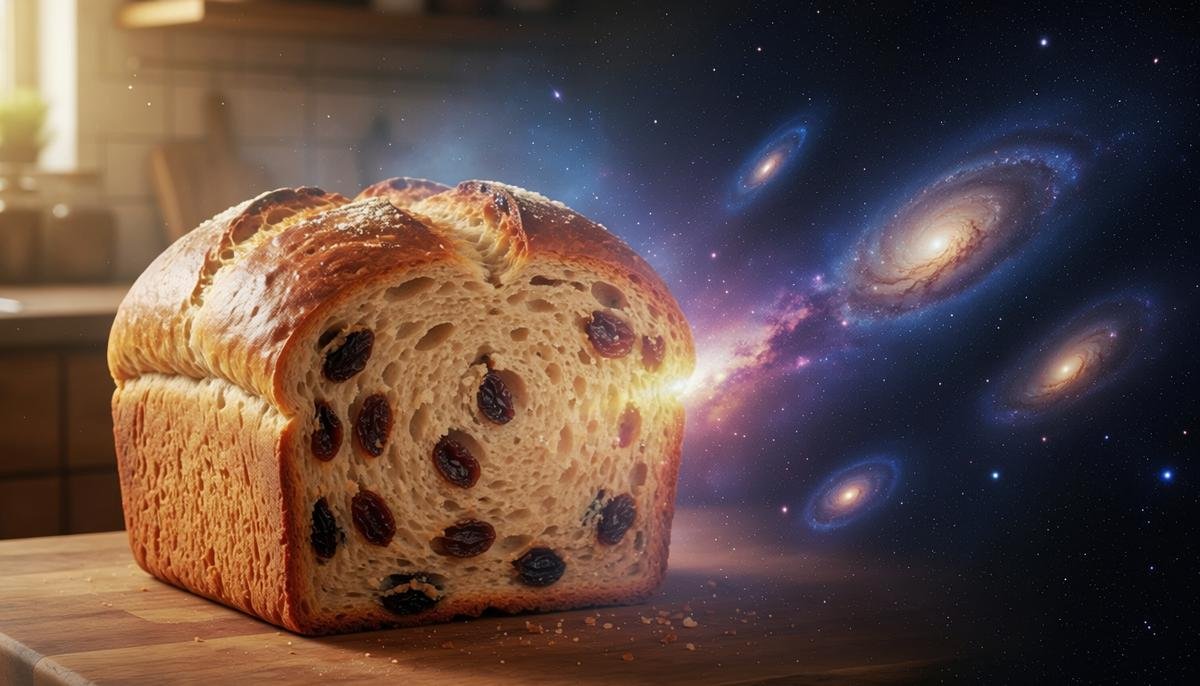
Here is the part that surprises everyone: the galaxies are not flying through space like debris from an explosion. Space itself is stretching, and it carries the galaxies along with it. Picture a loaf of raisin bread rising in the oven. As the dough swells, every raisin drifts away from every other raisin — and from the point of view of any single raisin, all the others seem to be retreating. That is exactly what we see from our own galaxy.
AI illustration generated with Adobe Firefly
Now play that expansion backwards. If everything is spreading apart today, then long ago everything was packed together. Wind the clock back 13.8 billion years and the entire universe was squeezed into a single, unimaginably hot and dense state. That beginning is the Big Bang — and it helps to be clear about what that means: not an explosion that went off inside space, but the rapid expansion of space itself, happening everywhere at once.
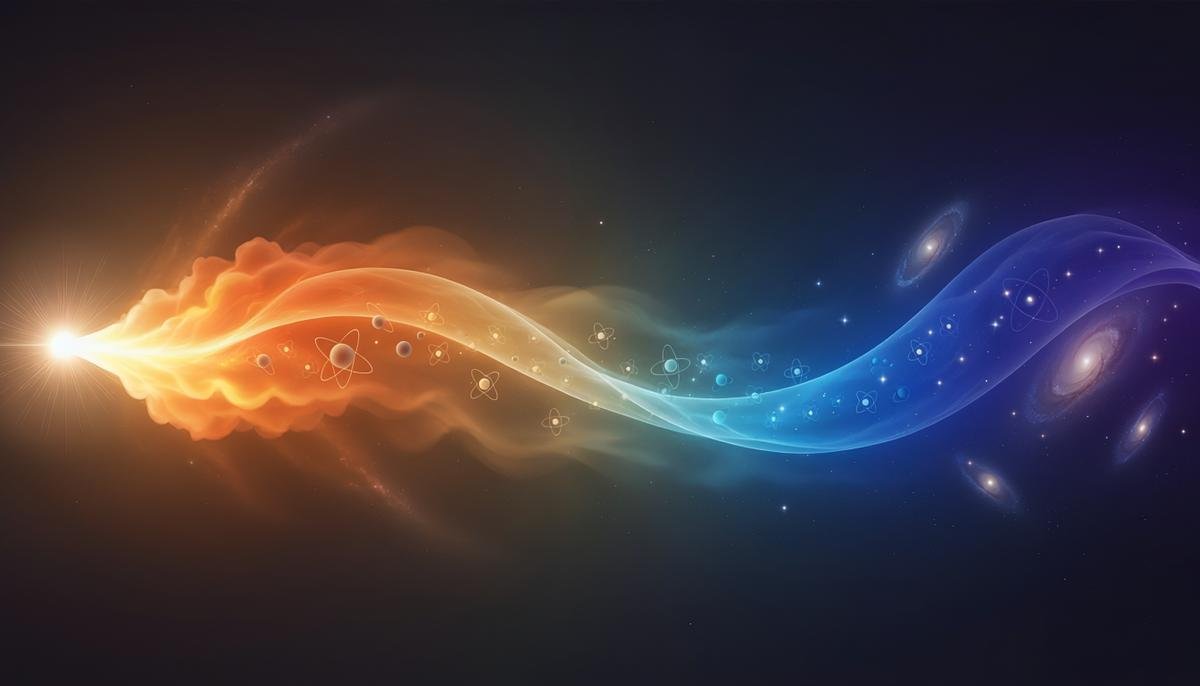
In the first few minutes, the heat forged the lightest elements — hydrogen, helium, and a trace of lithium. But the young universe was still far too hot for whole atoms to survive. Only after about 380,000 years did it cool enough for electrons to settle around nuclei and form the first stable atoms. At that moment, light was finally set free to travel across space.
AI illustration generated with Adobe Firefly
The day we accidentally heard the Big Bang. In 1964, two engineers, Arno Penzias and Robert Wilson, kept picking up a faint hiss in their antenna that came from every direction and refused to go away. It was not a fault in the equipment. They had stumbled onto the cosmic microwave background — that very first light, released 380,000 years after the beginning, now stretched and cooled to just 2.7 degrees above absolute zero. The discovery earned them the 1978 Nobel Prize and turned the Big Bang from an idea into something we can actually detect.
That ancient afterglow is also how we finally pinned down the age. By reading it in fine detail, the European Space Agency’s Planck satellite measured the universe at 13.8 billion years old. The jump from Ussher’s 6,000 years to 13.8 billion is a leap of more than two million-fold — and every step of it came from evidence, not assumption.
In short: The universe’s age leapt from about 6,000 years to 13.8 billion once we stopped counting generations and started reading the sky. Galaxies rushing apart let us rewind history to a single hot beginning — the Big Bang — and its leftover glow is the strongest proof we have that it really happened.
How Vast It Is — and How Its Stars Keep Burning
So the universe had a beginning, and it has been expanding ever since. That raises an obvious question: just how big has it grown, and what lights it up?
The numbers are hard to hold in your head. The part of the universe we can actually see — the observable universe — stretches about 93 billion light-years across. That may sound impossible for something only 13.8 billion years old, but remember that space kept expanding while the light was traveling toward us, carrying its sources ever farther away.
Inside that bubble, a University of Nottingham study estimated there are at least two trillion galaxies — ten times more than astronomers used to think — and our telescopes can still see only about a tenth of them. Each galaxy holds tens or hundreds of billions of stars. Add it all up, and the number of stars is something like a 1 followed by 24 zeros.
Every one of those countless stars is a furnace much like our own Sun — which raises a puzzle of its own. How can a star pour out light for billions of years without simply burning out?
The Sun is a fairly ordinary star, about 4.6 billion years old. Deep in its core, it fuses around 600 million tons of hydrogen into helium every single second, turning a tiny fraction of that mass into pure energy. Burning fuel that fast sounds like a recipe for a quick death — but the Sun is so enormous that even this furious rate barely makes a dent, and only its dense, scorching core is hot enough to fuse at all. That balance gives it a life of roughly 10 billion years, which means it is only about halfway through, with some five billion years still ahead.
In short: The observable universe spans about 93 billion light-years and holds an estimated two trillion galaxies — yet it may be only a small window onto something far larger. And every star in it, including our Sun, shines for so long because it is vast enough to burn its fuel slowly.
Why the Night Sky Is Dark — and Whether Time Had a Beginning
With two trillion galaxies and countless stars out there, here is a question that sounds childish but cuts right to the heart of the matter: why is the night sky dark?
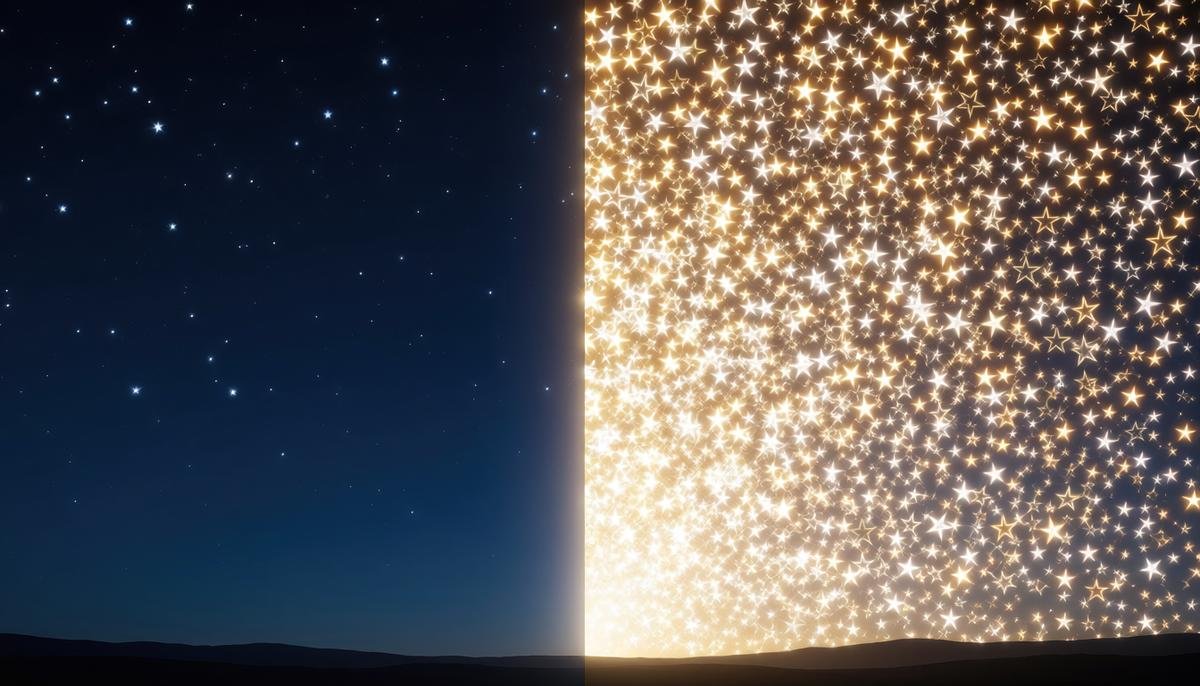
Think about it. If the universe were infinitely old and infinitely large, packed with stars in every direction, then no matter where you looked, your line of sight would eventually land on the surface of some star. The whole night sky should blaze as bright as the Sun. It doesn’t — and that simple fact is a real clue. It is called Olbers’ paradox, after the astronomer Heinrich Wilhelm Olbers, who described it in 1823 (though Kepler had wondered about it as early as 1610).
The resolution is beautiful. The night is dark because the universe is not infinitely old. Since it began 13.8 billion years ago, and light travels at a fixed speed, the light from the most distant regions simply has not had time to reach us yet. On top of that, the expansion of space stretches and dims whatever light does arrive. In other words, the darkness overhead is quiet evidence that the universe had a beginning.
AI illustration generated with Adobe Firefly
But if the universe had a beginning, a dizzying question follows: did time itself begin at the Big Bang? In 1983, Stephen Hawking and James Hartle offered an answer with their no-boundary proposal. Near the very beginning, they argued, time gradually blurs into space, so there may be no “before” to ask about at all. As Hawking liked to put it, asking what came before the Big Bang is like asking what lies north of the North Pole — you simply run out of road.
There is one last twist, and it links the largest things to the smallest. In its first instants, the infant universe was rippled by tiny quantum fluctuations — fleeting flickers that should have vanished in a flash. But as the universe ballooned, a few of them were stretched to enormous size. Those faint patches of slightly denser matter became the seeds that gravity slowly grew, over billions of years, into the galaxies and clusters that fill the sky today. The grandest structures we know were planted by the smallest.
What Understanding the Universe Means for Us
In roughly 2,500 years, we went from a small dome a few thousand years old to a 13.8-billion-year-old cosmos stretching 93 billion light-years — and not one step of that journey rested on faith or guesswork. It came from measuring shadows, reading the color of starlight, and listening to a hiss in an antenna. Understanding the universe has always been the same story: replacing certainty with curiosity, and curiosity with careful measurement.
And the story is personal. The hydrogen in your body was forged in the first minutes after the Big Bang; the heavier atoms were cooked inside stars and scattered when those stars died. You are, quite literally, made of cosmic history. The tale is also far from finished — dark matter, dark energy, and the ultimate fate of the universe are mysteries the next generation of telescopes is only beginning to unravel.
Frequently Asked Questions
How old is the universe?
About 13.8 billion years. The Planck satellite measured 13.787 billion years by reading the cosmic microwave background, the Big Bang’s leftover glow and a cornerstone of understanding the universe.
How big is the observable universe?
Roughly 93 billion light-years across. It is wider than its 13.8-billion-year age because space itself kept expanding while the light traveled toward us.
How many galaxies are in the universe?
Studies estimate at least two trillion galaxies in the observable universe, though current telescopes can see only about ten percent of them.
Why did people once think the universe was 6,000 years old?
In 1650 Archbishop James Ussher added up biblical genealogies and dated creation to 4004 BCE. It was a scriptural calculation, not a scientific measurement.
What was the Big Bang?
Not an explosion in space, but the rapid expansion of space itself from an extremely hot, dense beginning about 13.8 billion years ago.
How can the Sun shine for billions of years?
It fuses about 600 million tons of hydrogen into helium every second, yet it is so massive that this fuel lasts roughly 10 billion years.
Why is the night sky dark if space is full of stars?
This is Olbers’ paradox. The universe’s finite age means light from the most distant stars has not reached us yet, and expansion dims the rest.
What happened to the quantum ripples in the early universe?
Most were fleeting. But cosmic inflation stretched a few tiny quantum fluctuations to enormous size, and those density ripples grew into the galaxies we see today.
Did time itself begin at the Big Bang?
Possibly. Hawking and Hartle’s no-boundary idea suggests time blurs into space near the Big Bang, so there may be no ‘before’ to find.
Key takeaways
- In about 2,500 years, understanding the universe took us from a 6,000-year-old sky to a 13.8-billion-year-old cosmos.
- Around 240 BCE, Eratosthenes proved the cosmos could be measured, working out the Earth’s size from shadows alone.
- Galaxies racing apart let scientists rewind cosmic history to a single hot beginning: the Big Bang.
- The first atoms formed about 380,000 years after the Big Bang, releasing the light we now detect as the cosmic microwave background.
- The observable universe spans about 93 billion light-years and holds an estimated two trillion galaxies — yet may be a tiny part of the whole.
- A dark night sky is quiet proof that the universe had a beginning — the resolution of Olbers’ paradox.
AI-generated article · Research, writing, and images produced with AI tools · Multi-source verified · AI-level plagiarism-checked